


Crisp lettuce, crunchy croutons, salty-rich Parmesan and that creamy, tangy dressing – the Caesar is the salad that arrives with swagger, lifts the appetite and sets the tone for everything that follows. For a dish so often filed under “Italian”, its passport tells a different story altogether. The Caesar’s birthplace is not Rome but Tijuana, Mexico, where an Italian immigrant turned border-town necessity into culinary theatre, then into legend.
Before we tumble down the timeline, it helps to define the thing itself. A classic Caesar is deceptively simple: romaine lettuce for crunch and stamina, croutons for texture, Parmesan for a salty spark and a dressing that does the heavy lifting. That dressing is an emulsion scented with garlic and lemon, enriched with egg, sharpened with Worcestershire and anchovy, then glossed into a silken coat that clings to each leaf. The magic is that alchemy of salt, umami and citrus, a flavour profile that feels both indulgent and refreshing. Get the balance right and you understand why this salad has outlived countless trends.
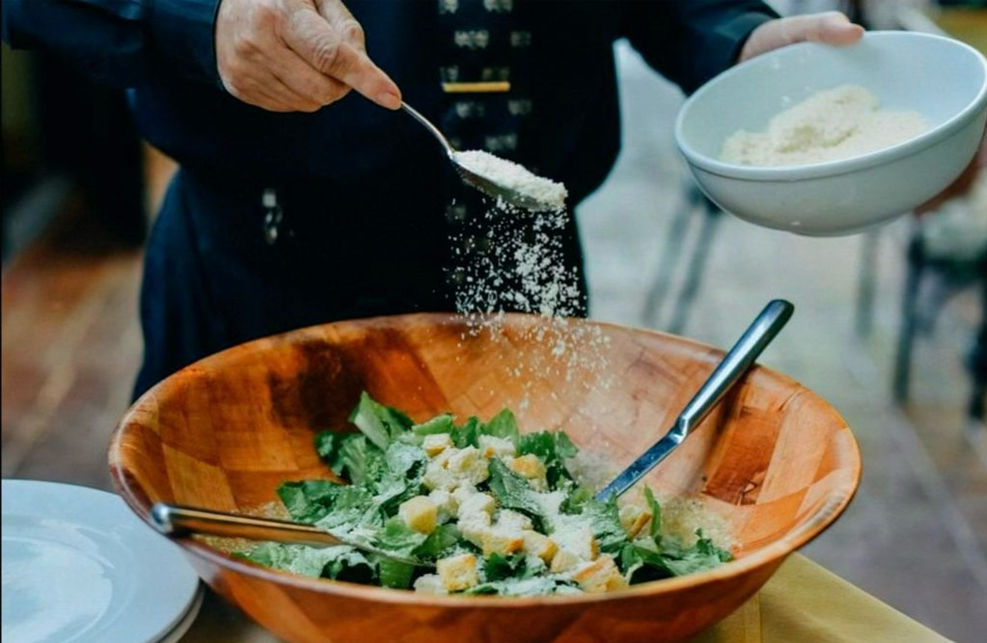
As for the origin, competing stories abound, but one narrative holds the most weight. On 4 July 1924, with Prohibition pushing Americans south for legal cocktails and late-night merriment, Caesar Cardini found his Tijuana restaurant heaving and his pantry stripped to its bones. Rather than close, he improvised: whole leaves to be eaten by hand, coddled egg, olive oil, lemon, and a generous handful of Parmesan. It was theatre as much as sustenance, mixed at the table in a large wooden bowl as diners looked on. Cardini’s brother, Alex – an aviator with a flair for showmanship – would later refine the ritual, tossing the salad, leaning into anchovies and reportedly dubbing it the Aviator’s Salad for his high-flying friends. Whether the spark belonged to Caesar or Alex, the effect was the same: a dish was born that tasted like glamour and felt like a night out.

The timing could not have been better. Tijuana was booming, a short drive from California, yet a world away in possibility. Hollywood studio insiders became regulars, then ambassadors. Julia Child recalled the thrill of crossing the border with her parents in the mid-1920s, lunching at Caesar’s and watching the performance unfold table-side. Recipes travelled home in pockets and notebooks. Restaurateurs borrowed, then adapted. By mid-century, the Caesar had landed at the Waldorf-Astoria, which in those days meant it had officially arrived. In 1948, Cardini bottled the dressing under trademark and the salad’s fame took on a second life in grocery aisles.
Along the way, the recipe evolved with America’s pantry. Early versions leaned on Worcestershire for the hint of anchovy, while later chefs steered straight into the fishy richness, pounding salt- or oil-packed fillets into a paste for maximum umami. Some stalwarts – including Julia in the 1970s – omitted anchovies entirely, preferring a gentler profile. The one constant was the insistence on freshness and drama. A Caesar was meant to be built at the last second, the emulsion whisked to shine, the leaves dressed, tossed and served before the crunch had time to fade. In that sense, it belonged to the same lineage as flambé: dining as performance, flavour as spectacle.
A century on, the Caesar remains irresistible because it is both comfort and contrast. The leaves are cool yet sturdy, the dressing rich yet bright, the croutons crunch while the cheese melts into silk. It flatters a glass of Champagne as easily as it shares a table with steak and chips. And for all the mythology, the lesson is simple: use the best ingredients, keep your nerve and serve it fresh. That’s how a border-town improvisation became the salad the world can’t stop ordering.
At Belthazar, we make our Caesar the way the story deserves – crisp leaves, house-baked croutons, proper Parmesan and a dressing stirred to a glossy finish that clings in all the right places. Start your meal with a classic that still knows how to steal the scene.
30 October 2025
